Webinars
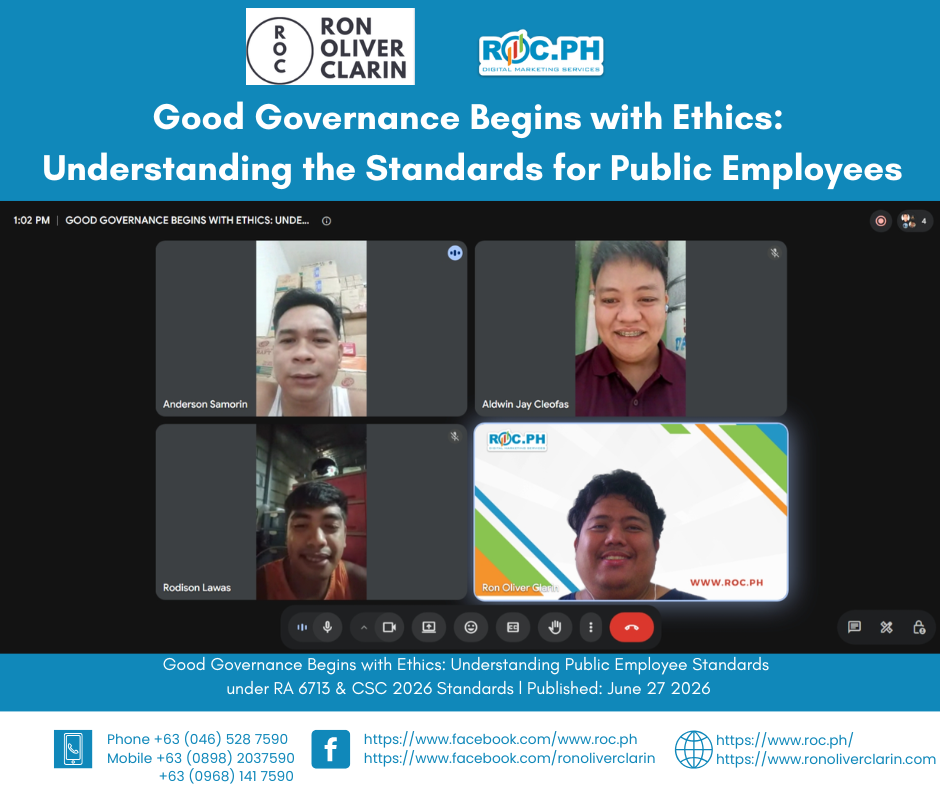
Good Governance Begins with Ethics: Understanding Public Employee Standards under RA 6713 & CSC 2026 Standards
Jun
Good Governance Begins with Ethics: Understanding Public Employee Standards under RA 6713 & CSC 2026 Standards
Public office in the Philippines is a public trust, governed by explicit legal mandates and evolving ethical frameworks. As of 2026, the Civil Service Commission (CSC) has shifted toward a proactive, competency-based framework that transforms ethics from a passive legal checklist into measurable, everyday actions. This comprehensive guide outlines the bedrock provisions of Republic Act No. 6713, the historic 2026 CSC policy updates, and an actionable decision-making framework for modern public servants.
1. The Constitutional & Statutory Bedrock
The mandate for absolute integrity is rooted in the highest law of the land:
Section 1, Article XI, 1987 Constitution of the Philippines:
“Public office is a public trust. Public officers and employees must, at all times, be accountable to the people, serve them with utmost responsibility, integrity, loyalty, and efficiency; act with patriotism and justice.”
To operationalize this constitutional mandate, Republic Act No. 6713 (The Code of Conduct and Ethical Standards for Public Officials and Employees) establishes the structural boundaries for everyone in government service.
The 8 Norms of Conduct (R.A. 6713)
Every civil servant is legally bound to observe eight distinct norms in their daily operations:
- Commitment to Public Interest: Prioritizing local and national public welfare over personal, political, or private convenience.
- Professionalism: Executing duties with a high degree of competence, diligence, and courtesy.
- Justness and Sincerity: Acting with complete fairness and without discrimination toward any citizen.
- Political Neutrality: Delivering administrative services impartially, without bias toward any political affiliation.
- Responsiveness to the Public: Acting swiftly on citizen needs, processing applications efficiently, and simplifying bureaucratic redundancies.
- Nationalism and Patriotism: Maintaining loyalty to the Republic and the Filipino people.
- Commitment to Democracy: Upholding democratic principles and maintaining public accountability.
- Simple Living: Maintaining a lifestyle appropriate to a public servant’s income; avoiding ostentatious displays of wealth.
2. The Historic 2026 CSC Regulatory Shift
Ethics in the Philippine civil service underwent a structural transformation in 2026, shifting how individual performance and character are evaluated.
The Competency-Based System (CSC Resolution No. 2600005)
Issued on March 30, 2026, this resolution marks the national transition to the Competency-Based Human Resource Management System (CBHRMS).
- From Passive to Active: Ethics and “Integrity” are no longer just concepts used to avoid penalties. They are now classified as an Active Core Competency.
- Performance Integration: Integrity is now actively observed, graded, and integrated directly into your performance assessments, recruitment eligibility, and organizational promotion paths. To advance your career in 2026, ethical behavior must be explicitly demonstrated and measurable.
Strict Workplace Discipline (CSC Resolution No. 2600111)
Addressing modern workplace environments, the CSC heavily enforces the Policy on the Prohibition of Gambling Among Government Officials and Employees.
- The Rule: Engaging in any form of gambling, including utilizing digital mobile betting and online gambling apps, is strictly prohibited during office hours or while inside government premises.
- The Penalty: Violations carry severe administrative penalties, emphasizing that civil service professionalism explicitly covers both digital and physical workspaces.
3. Defining Boundaries: Conflicts of Interest & Gifts
A primary source of administrative liability is the failure to recognize where personal lives intersect with professional regulations.
Managing Conflicts of Interest (Section 7, R.A. 6713)
A conflict of interest arises when a public employee’s personal finances, business ownership, or relationships intersect with their official regulatory duties.
- The Legal Mandate: Upon identifying a conflict, the employee is legally required to make an immediate disclosure and completely divest from the business interest or recuse themselves from the decision-making track.
Gift-Giving Boundaries
The law maintains an absolute prohibition on soliciting or accepting gifts, favors, culinary hospitality, or loans if it is tied to, or can influence, your official actions.
⚠️ The “Customary Practice” Trap: Relying on the excuse of “Ganyan naman po ang laging ginagawa dati” (that’s how we’ve always done it) is never a valid legal defense. Minor ethical oversights can quickly escalate into publicized Ombudsman complaints that threaten your pension, career, and institutional reputation.
4. The 4-Step Ethical Decision Framework
When faced with a high-pressure situation, use this structured checklist to ensure your actions remain transparent and legally defensible:
- Identify: Instantly determine if the scenario is governed by R.A. 6713, your specific agency’s internal regulations, or broader civil service laws.
- Analyze: Critically evaluate who stands to benefit from the choice. Is there a hidden conflict of interest or a potential public perception of bias?
- Consult: Do not resolve complex ethical issues in isolation. Proactively engage your HR officer, legal office, or compliance division for official guidance before taking administrative action.
- Document: Ensure every administrative decision and the reasoning behind it is transparently logged, providing a verifiable paper trail for future accountability.
5. Cultivating an Institutional Culture of Integrity
Good governance is built on individual, everyday choices to choose compliance over convenience. Organizations can foster this environment through four key pillars:
- Open Reporting: Establish safe channels for employees to flag internal compliance and ethical concerns early without fear of workplace retaliation.
- Observable Action: Leadership and staff must actively model the “Simple Living” and “Professionalism” norms in every public-facing interaction.
- Collective Duty: Adopt Civil Service Commission standards as the operational baseline for the entire team, rather than viewing them as a human resources checklist.
- Long-Term Vision: Treat ethical behavior as a critical core competency that actively shapes a public servant’s leadership potential.
🎟️ Missed the Live Session? Get Full Access Now!
If you were unable to attend the live training broadcast on June 27, 2026, you can still secure your training benefits. Get complete on-demand access to the training block to review the new 2026 regulatory shifts at your own pace.
- Full Access Pass Price: ₱500
- Inclusions: Full Recorded Webinar Session + Digital E-Certificate of Participation
📌 Get the Recorded Version & Certificate:
🔗 Purchase Full Webinar Access & E-Cert Here
