Uncategorized
The Dirty Truth About AI Bias: Why Artificial Intelligence Is Predictably Human
Nov
(Note: This article accompanies a special video presentation, conceptualized for an event keynote and brought to life using generative AI tools).—–Artificial intelligence is often framed as an objective, hyper-rational oracle capable of solving our greatest challenges without the emotional baggage of humanity. But if you cut through the fluffy marketing answers and look under the hood, a much messier reality emerges.
Let’s address the elephant in the server room: AI has a bias problem.
And the reason why isn’t a complex mystery—it’s actually very simple.—–
1. AI Eats Human History for Breakfast
Large Language Models (LLMs) and automated machine learning systems don’t generate logic out of thin air. They are trained on vast datasets derived from human decisions, writings, and behaviors.
In short: AI eats our past successes and failures for breakfast.
Because it feeds entirely on historical human data, the output is organic, messy, and deeply human. When you feed an algorithm decades of historical data—complete with existing systemic flaws, structural inequities, and cognitive shortcuts—the system doesn’t filter out those flaws; it learns them.
The result? AI becomes predictably biased.—–
2. Perfection Is a Myth: Aim for Vigilance Instead
Many organizations approach AI integration with the unrealistic expectation of achieving total objectivity right out of the box. However, eliminating bias completely is practically impossible when the training material itself is inherently human.
It’s not about being perfect. It’s about being aware and proactive.
Managing AI bias requires extensive self-awareness training for teams and constant vigilance on the part of developers and operators. Rather than trying to hide algorithmic flaws behind PR speak, leaders must foster a culture of transparency. When you are transparent about how a model reaches its conclusions and where its potential blind spots lie, you can actively design safeguards around them.—–
3. Honest Goal Setting: Know When to Automate
Navigating the future of technology isn’t an all-or-nothing proposition. Successful implementation hinges on honest goal setting and understanding the boundary between machine efficiency and human judgment.
- When to Automate: Streamline repetitive tasks, process massive datasets, and scale routine administrative workflows.
- When to Consult a Mentor/Human: High-stakes decision-making, ethical gray areas, nuance evaluation, and sensitive strategic planning.
You don’t need to automate everything, nor should you automate nothing. The sweet spot lies anywhere in between, provided there is human oversight keeping the algorithm accountable.—–
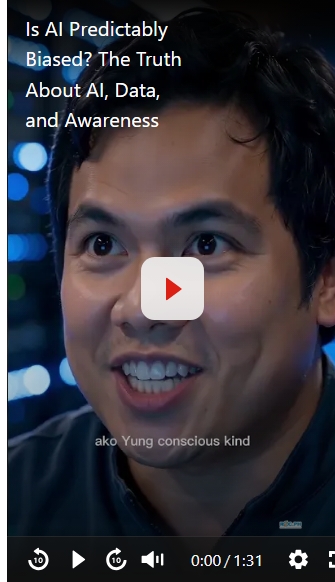
Watch the Video Presentation

Though technical glitches prevented this video from debuting live during the event, the message remains critical as we continue building and adopting automated tools.
Created by Ron Oliver Clarin using AI tools, the accompanying dialogue provides a raw, transparent look into how we can move past marketing hype and take proactive responsibility for the technology we build.—–Key Takeaways:
- AI bias is predictably human because models learn directly from human history.
- Tackling bias requires transparency, continuous awareness, and constant vigilance.
- Strive for proactive management rather than impossible perfection.
- Strike a balance between human mentorship and machine automation.
